Why Crypto Wallet UX Still Has a Long Way to Go
- By Caliper Studios
- March 20, 2026
- Insights, Deep Dives
Welcome to part two of our ongoing series of deep dives into the product segments we care about most. Having dedicated the first installment to centralized exchanges and their mobile apps, we thought it would only make sense to turn our attention to non-custodial wallets.
There is no shortage of coverage tracking the latest developments in this space. What we've found harder to come by is a design-first perspective on the products that serve as arguably the most important entry points to all things crypto. That's the gap we're trying to fill here.
For anyone looking to ground themselves in the current state of web3 wallet activity from an economic perspective, we recommend Filippo Armani's Wallet Report v2 on Dune.
Non-custodial vs. Custodial
If you're reading this, you probably don't need a lengthy intro regarding the differences between custodial and non-custodial wallets.
Where custodial providers like Coinbase and Binance store private keys for their users on their infrastructure, non-custodial wallets leave that responsibility entirely to the user. The choice comes down to convenience versus sovereignty.
Sure, handing your keys to a third party is undeniably convenient, but do we trust them enough to manage what might be our life savings? The collapses of FTX and Mt. Gox made that question painfully relevant, leaving users to spend years fighting to recover whatever was left of their funds.
Going non-custodial eliminates (or at least significantly reduces) the counterparty risk. The tradeoff is that you are now fully in charge of your own keys, which is not without its own pitfalls. Have you taken every precaution to protect against malicious actors? And are you confident you will still be able to access those keys ten years from now? History has shown that people tend to lose their keys regularly. Some estimate that 10-20% of Bitcoin’s entire supply has been lost due to this exact problem.
The decision is not an easy one to make. Luckily, wallet developers are well-aware of that problem and have made continued efforts to evolve the category to incorporate technologies that mitigate some of the difficulties that arise when users have to take care of their own keys.
Different Wallet Types
The crypto wallet space is incredibly fragmented. We already covered the difference between custodial and non-custodial wallets, but even amongst non-custodial wallet apps, further subcategories emerge that need to be understood.
The foundational type is the Externally Owned Account (EOAs), the OG of crypto wallets (at least on smart contract compatible chains like Ethereum). EOAs make up the vast majority of wallets out there, but they come with quite a few downsides: lose your private key or seed phrase and you lose everything. Full stop.
There is no shortage of non-custodial wallet apps competing for market share. Some try to do it all, while some cater to certain niches and ecosystems.
This problem is what led the almighty blockchain wizards to develop the so called Smart Contract Accounts (SCAs), also known as Smart Contract Wallets or Account Abstraction wallets. SCAs have existed in various forms since the early days of Ethereum, but became popular with the launch of the ERC-4337 standard in March 2023, which brought a unified and widely adopted approach to the concept. Rather than relying on a single private key, SCAs offset the account logic through on-chain code, unlocking security improvements, social account recovery, transaction batching, and the ability to pay gas in tokens other than ETH—among other good stuff.
Smart Contract Accounts are not without tradeoffs though. They are more complex, smart contract code can carry vulnerabilities, and social recovery methods introduce their own attack surface. So the wizards went back to the drawing board and gave us EIP-7702, a clever hybrid architecture that allows an existing EOA to temporarily inherit smart contract capabilities, without the need to migrate to an entirely new account. A step in the right direction, but surely not without its own set of inherited problems, risks, and tradeoffs.
We could go further down this rabbit hole (MPC or embedded wallets, anyone?) but that falls outside the scope of this article. What we will say is that wallet and blockchain developers around the world are working hard on architecture improvements that promise better wallet UX, and while the progress is real, we believe much of it is actually more confusing than anything else for the average user.
Different architectures enable different feature sets, onboarding flows, and recovery methods, but they don't fully eradicate the chances of human error. They risk instilling a false sense of security, and perhaps most importantly, they can prevent users from learning about proper key management and security hygiene. Accounts can still get hacked, passkeys can be lost or overwritten, and none of that changes that.
The Common Design Pitfalls
Most non-custodial wallets are very comparable in terms of feature scope. Some cater to specific niches, whether from a use case or ecosystem perspective, but at the highest level the functionality on offer is largely the same across the board.
While that might sound like a limitation, we actually believe this is the perfect condition for product design to take center stage. The learning curve for crypto is still very steep, and the wallets that pull ahead are the ones that provide the most straightforward user experience.
Our assessment is based on the app experience as a whole, but certain features and flows are obviously more important than others. The aspects we paid closest attention to are the following:
Onboarding and Key Management. The first time a new user creates a wallet is obviously critical, but how the app guides users through key backups matters just as much. This is where habits are formed (for better or worse)
Transaction Signing. Confirming transactions is one of the most commonly cited pain points in crypto. It can be intimidating, it is frequently misunderstood, and when done incorrectly it can lead to loss of funds.
Deposits. As straightforward as it might seem, the way deposit addresses and QR codes are presented, and where the relevant CTAs are placed, continues to surprise us across wallets.
Multi-Chain Management. Many tokens exist across multiple blockchains simultaneously. How a wallet presents assets across different networks can quickly become confusing depending on how balances are surfaced and organized.
Fiat Rails and Swaps. Buying, selling, and swapping crypto on non-custodial wallets almost always requires third-party integrations. The quality of those integrations varies considerably from wallet to wallet.
Beyond these, one of the things we always keep a close eye on is the overall hierarchy of features within the app. Does it feel intuitive? Is everything where you would expect it to be, and if not, is it easy to find regardless? Are there repetitive entry points, and do they actually need to be there? These are the kinds of questions we ask ourselves when assessing almost any digital product.
The Shortlist
As always, we want to spend a little time with the products that make up the space. For this deep dive, we organized our selections into two categories: the top dogs, and the ones that we believe are worth keeping an eye on.
| Name | Founded | Region | Group |
|---|---|---|---|
| MetaMask | 2016 | ConsenSys | Top Dog |
| Trust Wallet | 2017 | Binance | Top Dog |
| Base App (aka Coinbase Wallet) | 2017 | Coinbase | Top Dog |
| Phantom | 2019 | Phantom Technologies | Top Dog |
| Family Wallet | 2024 | Avara | Our Favorites |
| Uniswap Wallet | 2023 | Uniswap | Our Favorites |
| World App | 2023 | Tools for Humanity | Our Favorites |
| Xverse | 2022 | Secret Key Labs | Our Favorites |
The labels speak for themselves. The top dogs are the market-dominating apps that most people will already be well-familiar with. Our favorites are a selection of carefully considered apps that we believe get a few things very right, and from which their more established counterparts could still learn a lesson or two.
The Top Dogs
Recent years have seen a significant chunk of volume e.g. market share being pulled to exchange-embedded wallets like those present in OKX’s and Binance’s wallet. While those are technically self-custodial wallets, we’re going to focus on the pure-breads in this section: the wallets that are commonly associated with the category.
MetaMask
MetaMask hardly needs an introduction. Launched by blockchain infrastructure specialist Consensys in 2016, it has long dominated the wallet market and counts around 30 million monthly active users as of 2025. Much of that user base was built during the DeFi summer of 2021, when MetaMask's broad support for Ethereum and EVM-compatible chains made it the go-to tool for navigating decentralized exchanges, staking protocols, NFT marketplaces, and Play-to-Earn games. For a lot of people, MetaMask was crypto.
First-mover advantage played no small role in that dominance. Consensys had MetaMask's Chrome extension ready at precisely the moment the web3 craze took off, while other wallet teams were still scrambling to launch a competing product. That made MetaMask the default point of entry for an entire generation of DeFi newcomers in 2020 and 2021, many of whom had no alternative to compare it against. It owned the category before the category fully existed.
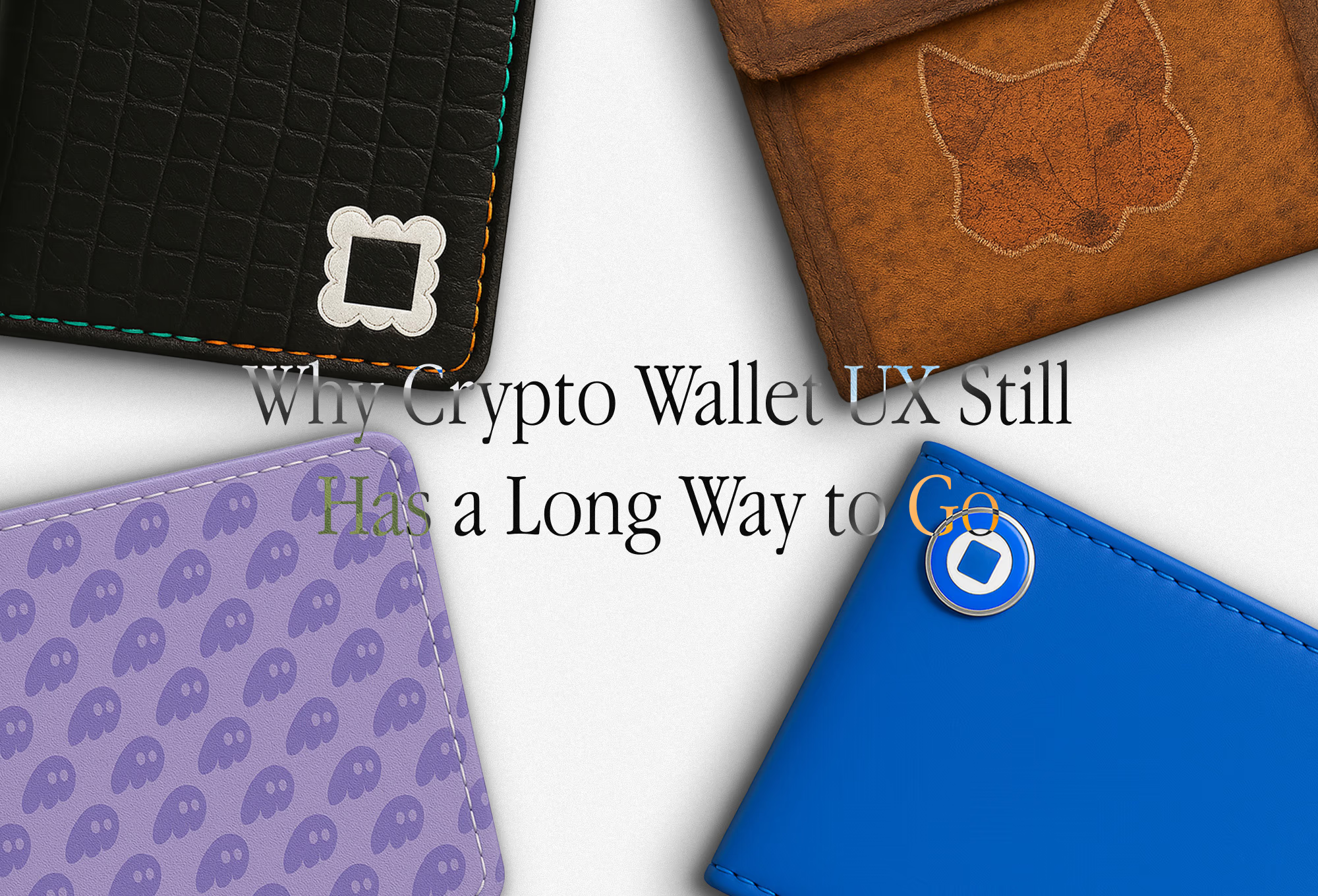
MetaMask has been dominating the space for a long time, but received a lot of criticism for its outdated UX/UI with the emergence of design-focused competitors.
That reputation took a hit in the years that followed, when MetaMask attracted sustained criticism for the UX/UI of both the browser extension and mobile app. The interface felt dated, menu structures were confusing, and critical flows had a tendency to dead-end without proper guidance. Information was often presented in ways that overwhelmed rather than informed. The transaction history details usually being a particularly glaring example: overflow issues, missing date groupings, and poor visual hierarchy made it genuinely difficult to parse what had happened to your funds.
The issues weren't limited to design decisions either. From a front-end implementation standpoint, the cracks were equally visible. Components behaved inconsistently across device types, loading states felt poorly coordinated, and the overall product gave the impression of a codebase straining under the weight of years of accumulated decisions.
The good news is that Consensys has been listening. The team has shipped a meaningful volume of updates throughout 2025 that show a clear awareness of the gap between MetaMask and its more design-forward competitors. Some rough edges remain: inconsistent component usage, choppy transitions, and implementation quirks that frequently break the sense of a cohesive experience. Given MetaMask's reach, getting the experience right carries consequences that go well beyond its own market share.
Trust Wallet
Trust Wallet is another all-star option deeply rooted in the history of crypto. Developed by Viktor Radchenko in 2017, Trust Wallet took a different approach from MetaMask by focusing on onboarding people into crypto and web3 through mobile apps rather than browser extensions.
That focus paid off quickly. The app gained traction fast enough to attract Binance's attention, leading to an acquisition in July 2018 after which Trust Wallet was designated Binance's official wallet. The move was almost certainly strategic, positioning Binance for the eventual launch of Binance Smart Chain and its ambitions in the broader web3 and DeFi space.
Trust Wallet used to be known for its simplicity and accessibility, but has continued to add features that make the experience feel overwhelming.
For a long time, Trust Wallet's reputation rested on exactly the kind of simplicity that MetaMask struggled to deliver. A straightforward user interface that got out of the user's way. That began to shift in October 2023, when the team rolled out its first major redesign. The updated interface brought Trust Wallet visually closer to the broader Binance design language, and with it came a wave of new features and integrations that reflect the product's growing ambitions.
The challenge is that ambition and simplicity can pull in opposite directions. The feature hierarchy has grown dense, and the mobile app’s UI is riddled with inconsistencies and bugs. With so much competing for the user's attention, it can be easy to lose sight of what made Trust Wallet special in the first place: helping people manage their portfolio with as little friction as possible.
We're still big fans. The brand carries genuine weight in the space, the foundation is strong, and the potential is clearly there. If the team can find a way to channel its ambitions without sacrificing the clarity that defined its early years, Trust Wallet could reassert itself as the go-to non-custodial experience for mainstream users.
Base App (formerly Coinbase Wallet)
Initially launched as Toshi in 2017, Coinbase's non-custodial wallet was rebranded to Coinbase Wallet in August 2018 and has the distinction of being the world's first wallet to support both dApps and NFTs (CryptoKitties collectors will remember it well). For years it was considered to be one of the most approachable products in the space and managed to upkeep that reputation for many versions of the app.
That reputation has been tested by a few strenuous years of redesigns, the most drastic of which arrived in July 2025 when Coinbase made the decision to rebrand Coinbase Wallet to Base App. The idea being to double down on its own L2 network of the same name in the process, and to promote user activity that goes beyond just trading and transacting.

Recent updates to Base App have brought the experience closer to its roots. It started off as a superapp experiment, but is now once again a wallet.
The ambition was clear. The execution, at least in the initial beta rollout, was harder to read. What had been one of the cleanest wallet experiences in all of crypto suddenly found itself trying to be several things at once: part wallet, part social feed, part mini-program platform. The result felt, at least to us, like a mashup of X's social feed and WeChat's mini app platform, rather than a crypto wallet experience.
We obviously don’t have too much visibility into what the team at Coinbase was thinking, but it’s fair to assume that the perception internally wasn’t far off how we’re feeling about this hybrid approach. Since its released in the form a secondary mode within in the Coinbase Wallet App (we already expressed how to feel about mode toggles in our deep dive on exchanges), the architecture of Base App has been changed several times to go back to its roots and once again be closer to transacting, rather than anything else.
As per Base App’s official announcement on X in Feb 2026, a feed focused on tradable assets remains, but has been toned down in the general hierarchy of features. We're glad the app has found its footing again, even if the road there was slightly bumpier than it needed to be.
Phantom Wallet
Phantom is the wallet of choice for all things Solana. Founded in early 2021, it initially launched as a browser extension for the Solana ecosystem, taking clear inspiration from their colleagues at Consensys. The timing was perfect as the extension arrived during a period of robust growth for Solana.
Multi-chain support followed in late 2022 and into 2023, bringing all things Ethereum and Bitcoin into the fold, with further chain additions continuing at a steady pace ever since. User numbers peaked during the memecoin frenzy on Solana in early 2025, a moment that stress-tested the app at scale.

Phantom is a truly outstanding example of what a wallet should look and feel like. The product and experience are feature rich, but accessible.
We consider Phantom to be the one truly outstanding wallet experience in the crypto ecosystem right now. The team has done exceptional work on both the interface and the overall experience, and what's particularly impressive is how they've managed to keep adding features without things getting messy. New chains, asset classes, swaps, dApps, onramps, debit cards, and simple social features all feel genuinely considered. Everything has a very clear and distinct place in the product’s feature hierarchy. Nothing feels bolted on awkwardly.
The UI is remarkably consistent across the entire product. A good example of this is Phantom's implementation of HyperLiquid's perpetuals trading, rolled out in the second half of 2025. Perp DEX user interfaces are notorious for being overwhelming, but Phantom's take stands out as the most accessible and well-executed version currently available.
Design quality and front-end execution go hand in hand here. The small UI bugs, inconsistent component behavior, and loading state issues that quietly undermine so many wallet experiences are largely absent. The whole thing simply feels polished through and through.
Perhaps the most telling sign of Phantom's standing is the degree to which it has become a reference point for the rest of the industry. We've observed design updates across the wallet segment that are clearly inspired by Phantom's design patterns. In a space still figuring out what good looks like, that's about as close to a consensus standard as it gets.
Our Favorites
Beyond the household names, there's a tier of wallets worth paying close attention to. Some cater to specific use cases or particular ecosystems and may not command the same market share as their more established counterparts. However, what they lack in scale and reach, they make up for in terms of craft and consistency.
Family Wallet
Family Wallet has had a short run, but it has been the design community's darling for much of it. Developed by Los Feliz Engineering (LFE) and launched in 2023 as an iOS-only experience, Family was focused solely on Ethereum, Ethereum L2s, and EVM-compatible chains like Avalanche and BSC. Its mission statement is to make web3 fun, and it delivers on that through what are arguably the most beautiful microinteractions in the space. The UI is exceptionally well-executed, consistent throughout, and the attention paid to transitions and details makes the app genuinely delightful to use.

Family Wallet may be winding down, but its meticulous micro-interactions set a standard that the rest of the space would do well to pay attention to.
That same attention to detail does come with a tradeoff though. At times, elements transition unpredictably and new screens slide in inconsistently, which can feel disorienting. It's a rare case where the pursuit of polish at the UI level appears to have come at a minor cost to UX coherence. A small criticism in the context of an otherwise outstanding product.
Family Wallet remains one of the very few crypto products that demonstrates what the category can look and feel like when real craft is applied. We encourage anyone who hasn't tried it to do so while they still can.
Avara (the company behind Aave) acquired Family in November 2023 and announced that it will stop onboarding new users on April 1, 2026, and sunset the app entirely the following year. We're sad to see it go, but encouraged by what comes next: Aave's recently announced iOS app bears Family's DNA clearly enough that the team's work is anything but lost. We're happy to see Aave taking design seriously, and hope it inspires others in the industry to follow suit.
Uniswap Wallet
Uniswap has been one of the most important DeFi protocols since its inception on Ethereum in 2018, popularizing the AMM model that now underpins most of the space and consistently pushing some of the highest swap volumes in the industry.
What has always set Uniswap apart, beyond the protocol itself, is a genuine sense of design. Across both product and brand, pretty much everything the company ships has an elevated quality to it that is rare in this space. That sensibility extends to its standalone mobile wallet released in 2023.

One has to give Uniswap credit for its heightened sense of design across all touch points. And its swap focused wallet app is no exception.
World App
Few projects in this space divide opinion quite like World. Developed by Tools for Humanity in 2019 (a company within Sam Altman’s ecosystem of projects), its mission is to build a global digital identity and payments system backed by its own technology stack.
The controversy is largely centered on how World IDs are assigned: through a retinal scan performed by one of the project's so-called Orb devices. The mechanism is designed to ensure that every participant is human and can only have a single ID. The idea of having biometric data tied to an on-chain identity managed by a third party is understandably giving many people chills.

All controversy aside, one cannot fault World App for its excellent execution from a product design standpoint.
At the center of it all sits the World App. It manages your World ID, serves as a wallet for both digital assets and fiat currencies, and provides access to third-party services through a rapidly expanding catalogue of Mini Apps.
Whatever one's position on the project's mission, the execution from a product and design perspective is difficult to fault. We consider the World App to be among the most outstanding examples of wallet apps in the space. It is minimalistic, both aesthetically and functionally, and manages to break from the common UX/UI patterns seen across most wallets without feeling overly experimental. Components, patterns, and screen transitions are all slightly distinctive without ever being confusing, and the consistency across the entire experience is exceptional.
That design sensibility extends well beyond the app itself. From the website to the hardware design of the retina scanning Orb, everything World touches carries the same heightened sense of craft. That kind of end-to-end coherence is rare anywhere, and almost unheard of in crypto.
Xverse
We wanted to close this section with a strong example from the Bitcoin ecosystem, and think that Xverse is the clear choice.
First rolled out in 2021, Xverse's mobile app was built to cater specifically to the needs of the Bitcoin community. It was among the first wallets to support the Stacks ecosystem, and was an early mover on BRC-20, Runes, and Ordinals: the bitcoin-based inscription and token standards that got popular throughout 2023/24.

We’re glad to see a few products solely focused on the Bitcoin ecosystem taking design seriously. Xverse is surely one of those standout examples.
Xverse may not be as flashy as some of the other apps previously highlighted, but it doesn't need to be. The UI is simple, attractive, and consistent, and the front-end implementation is of a genuinely high standard. For a wallet operating in a niche that larger, chain-agnostic competitors have largely ignored, that level of execution clearly stands out. Plenty to learn here for some of the bigger players.
We don't know exactly what the future of Bitcoin L2s looks like, but we're confident that Xverse is well positioned to make whatever comes next as accessible as possible. We'll be keeping a close eye on them, and we're glad that this corner of the ecosystem has at least one wallet that's on the right path from a design perspective.
The Road Ahead
Had we written this article a year or two ago, our overall assessment of the status quo of product design in the wallet space would have been considerably grimmer, particularly when it comes to the more established players. A lot has changed. Many of the issues that have long plagued the apps of some of the more established wallet developers have been at least partially addressed by updates that shipped over the past year. The direction we’re headed in is encouraging.
We believe Phantom has played a significant role in this shift. Its rise has pushed wallet developers across the board to take design more seriously, which is undoubtedly good for users. That being said, the side effect is that we're seeing a growing number of apps take a little too much inspiration from Phantom's playbook. We won't point fingers, but the patterns are recognizable. Imitation may be the sincerest form of flattery, but it rarely produces the best products.
We sincerely hope that wallet makers will come to realize that design is one of the most underutilized differentiators in the space. Products that genuinely invest in product design have a meaningful competitive advantage, and that advantage compounds over time. But that investment has to go deeper than just pretty Figma canvases. Shipping a product that's fully aligned with its original design intention requires close, ongoing collaboration between design and development, and that's a cultural commitment as much as a technical one. The product is the brand. There is no separation.
We still see gaps here among the larger, more established wallet apps. But we see a lot of the smaller teams, working on more focused and niche products, who are clearly on the right path, and we’re optimistic about what’s coming next.
The future is bright. We're looking forward to building it with you.
Get in touch
Though headquartered in Hong Kong, our team and partner network extend internationally, enabling us to work with clients across borders and time zones.
Get in touch to discuss your next project. We are open to discussing scope, requirements, and next steps.
- New Business projects@caliper.studio
- General Inquiries general@caliper.studio